2012年12月10日 星期一

illumina experiment

www.perkinelmer.com/pdfs/downloads/CST_RGHS_UK_NGS_Magrini.pdf
1. We sholud the data content Reference: NGS Sample Prep Challenges


2012年12月8日 星期六

Transcription factor


1. What Transcription factor  ??

In molecular biology and genetics, a transcription factor (sometimes called a sequence-specific DNA-binding factor) is a protein that binds to specific DNA sequences, thereby controlling the flow (or transcription) of genetic information from DNA to mRNA.Transcription factors perform this function alone or with other proteins in a complex, by promoting (as an activator), or blocking (as a repressor) the recruitment of RNA polymerase (the enzyme that performs the transcription of genetic information from DNA to RNA) to specific genes


Referencee:
wiki
Advance

2012年12月6日 星期四

illumin read and phred 33


Illumina reads:
@ + [Read Name] + [Paried_Direction(1/2)]
@HWI-ST688:211:C0F02ACXX:6:1101:12568:67545 2:N:0:AGTCAA
GGGAGGAAGGTGCAGGTCCCTCTGCCCTTTCTGCCAAGGTGCAGAATAGCGCCCGGGCGTGTGTTTTGGCTCCAGAGCAGTTCCACGTGGAGCAACTTCGT
+
BCCFFFFFHHFHHJJJHIJJJJJJJJJIJJJJJJJJIJJ?FGHJGIGIHIGGHIIJHHD>@;AACDDDD:ACDDDDDDDDCDDDEDDBDDBDDBDDDDD@#
@HWI-ST688:211:C0F02ACXX:6:1101:12568:67545 1:N:0:AGTCAA
CCTCCTCACAGATCAAGTACACAACACACACACACACACACACACACACACACGAAGTTGCTCCACGTGGAACTGCTCTGGAACCAAAACACACGCCCGGG
+
CC@FFFFFHHHHHJJJJGIJJJJJIJJJJJIJJJJJJJJJJJIJJJJJJJJIHFEFF?>ACACDCDD?ABDDDCC>ACDCDC(9<ABBBDDDBB>>BB<55

[From http://en.wikipedia.org/wiki/FASTQ_format]

--------------------------------
TruSeq / Quality 101 / Quality Scores Overview
Quality Scores
Quality scores measure the probability that a base is called incorrectly. With SBS technology, each base in a read is assigned a quality score by a phred-like algorithm1,2, similar to that originally developed for Sanger sequencing experiments. The quality score of a given base, Q, is defined by the equation
Q = -10log10(e)
where e is the estimated probability of the base call being wrong. Thus, a higher quality score indicates a smaller probability of error. In the table below, a quality score of 20 represents an error rate of 1 in 100, with a corresponding call accuracy of 99%.
The Relationship Between Quality Score and Base Call Accuracy Quality Score Probability of Incorrect Base Call Inferred Base Call Accuracy
10 (Q10) 1 in 10 90%
20 (Q20) 1 in 100 99%
30 (Q30) 1 in 1000 99.9%
From [http://www.illumina.com/truseq/quality_101/quality_scores.ilmn]

Phred 33:
How are qualities scaled?
Q = ord(q) - 33
q = chr(Q+33)
Q  integer quality
q  character representation
[From http://www.google.com/url?q=http://faculty.washington.edu/jht/GS373_2010/lectures/G373_Shendure_Wk9_Monday_lec24.pdf&sa=U&ei=-4fBULi5DM6WmQWc9YCgDA&ved=0CBcQFjAA&sig2=cLOTAx1vQje5eSYCseyaOg&usg=AFQjCNFWi32peUKA4MaYr6_dEEGgGDD7WA]

2012年12月5日 星期三

Primer and random primer

1. What is a primer?

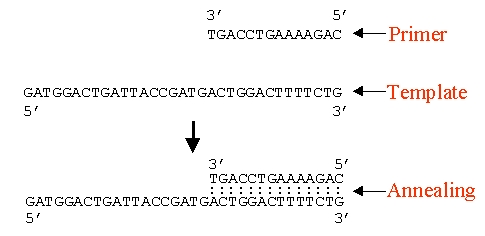
A primer is a short synthetic oligonucleotide which is used in many molecular techniques from PCR to DNA sequencing.  These primers are designed to have a sequence which is the reverse complement of a region of template or target DNA to which we wish the primer to anneal.   


Reference: What is a primer


2. What is a random primer?? 
Random primers are short segments of single-stranded DNA (ssDNA) called oligonucleotides, or oligos for short. These oligos are only 8 nucleotides long (octamers) and they consist of every possible combination of bases which means there must be 48 = 65,536 different combinations in the mixture. Because every possible hexamer is present, these primers can bind to any section of DNA.


 Reference: random primer


3. More about primer

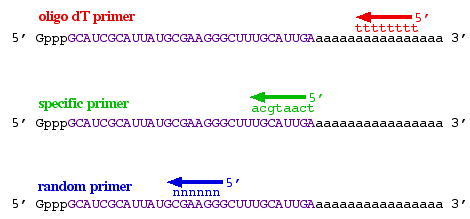
The only issue worth mentioning now is that three different types of primers can be used (figure 3). 1) 

  • If the mRNA has a poly-A 3' tail, then an oligo-dT primer can be used to prime all mRNAs simultaneously. 2) 
  • If you only wanted to produce cDNA from a subset of all mRNA, then a sequence-specific primer could be used that wil only bind to one mRNA sequence. 3) 
  • If you wanted to produce pieces of cDNA that were scattered all over the mRNA, then you could use a random primer cocktail that would produce cDNA from all mRNAs but the cDNAs would not be full length. 


The major benefits to random priming are the production of shorter cDNA fragments and increasing the probability that 5' ends of the mRNA would be converted to cDNA. Because reverse transcriptase does not usually reach the 5' end of long mRNAs, random primers can be beneficial


Reference: primer and CDNA


CDS and exon relationship

1. what is cds?

the gene coding sequence. and is composed of many exon.


Refernece:
What's the difference between CDS and ORF?

Sensitive and specific Reference

1. 究的實驗分析:敏感性、特殊性

2. P-value 的 Multiple test correction

2012年12月3日 星期一

SAM file format

1. About SAM format
SAM is (Sequence Alignment/Map) format

2. Field introduction
Office File


3. Flag expalin
  read paired
  read mapped in proper pair
  read unmapped
  mate unmapped
  read reverse strand
  mate reverse strand
  first in pair
  second in pair
  not primary alignment
  read fails platform/vendor quality checks
  read is PCR or optical duplicate
Reference: Web SAM Flag


3. Example
 Reference: Detail Example


4. Paired-End Flag
  • 163: read paired, read mapped in proper, mate reverse, second in pair
  • 83  : rad paired, read mapped in proper, read reverse, first in pair
  • 67: read paired, read mapped in proper, fist in parir
  • 131: read paired, read mapped in proper, second in pair 
  • 99: read pair, read mapped in proper, mate reverse, fist in pair
  • 147: read pair, read mapped in proper, read reverse, second in pair


5. Paired insert length calculation
 Reference: Paired insert length